

What prompts search engine interest in climate change?
Most Americans have taken notice of increases in extreme weather

The Yale Program on Climate Change Communication’s research is always freely available at our website. This week, we’re posting our findings from August - join our mailing list here to get early access to the latest YPCCC research and tools.
Dear Friends,
In recent weeks, a majority of Americans have experienced extreme heatwaves that have pushed summer temperatures to record-breaking highs in places like New York, Washington, D.C., and Philadelphia. As the effects of climate change continue to mount, extreme weather events have become more frequent, requiring more people to adapt. But does this rise in frequency cause people to connect the dots between climate change and extreme weather?
Most Americans have taken notice. According to the latest figures from the Yale Climate Opinion Maps, 65% of adults in the United States somewhat or strongly agree that global warming is affecting the weather, while 72% of adults nationally think global warming is happening. This gives important insights into current perceptions, and reflects an increase in awareness over time. But when do people want to learn more about climate change, and what prompts their interest?
Such questions about public behaviors can be difficult to answer, as many studies on climate change interest rely on self-reported survey responses with unavoidable lags in data collection. In a research collaboration with Google, we examined Search trends across the United States, providing timely snapshots of where people’s interests lie. We found that Search trends on climate change follow a consistent, predictable pattern. We highlight two of our findings below: one on the cyclical pattern of climate change interest, and another on responses to extreme weather events.
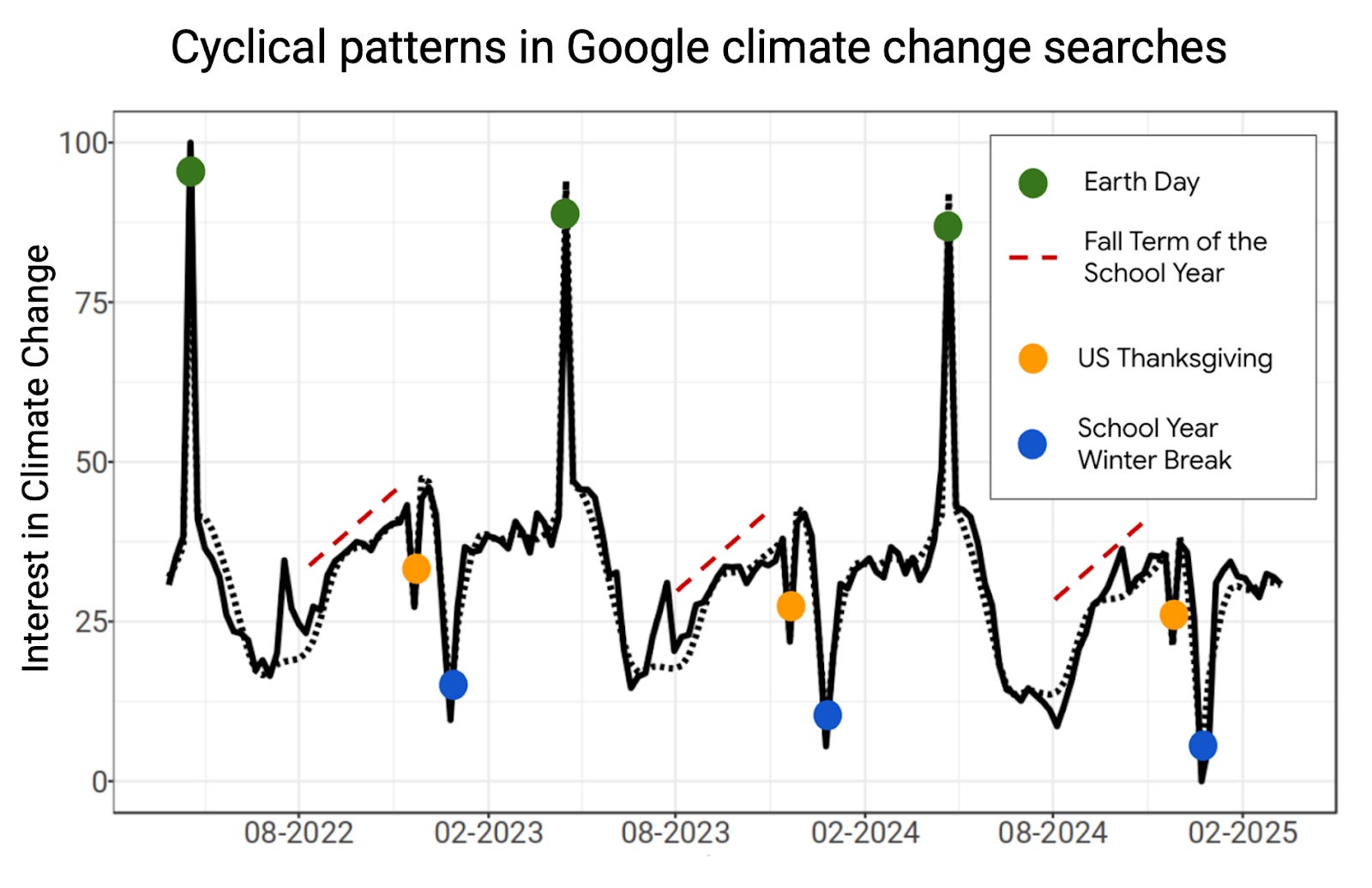
Search interest in climate change (measured on a relative scale) follows cycles largely defined by (1) Earth Day, and (2) the school year. On Earth Day, the Doodle on google.com sometimes links to the Search results page for climate change, which likely contributes some to the spike in traffic we see in this graph. Other trends follow notable periods in the American school year: Search interest in climate change increases as the fall term begins, and predictably dips during the holidays before picking back up in the spring.
But these regular cyclical effects aren’t the only triggers of interest in climate change. Extreme weather events also matter. Even after adjusting for Earth Day and the school year, there’s still a lot of variation in Search interest that correlates with extreme weather events.
How extreme weather events affect Google Search queries for climate change
Certain weather events—like heat waves—seem to produce consistent jumps in climate change interest across all regions simultaneously, while others—like wildfires—show more geographic variation.
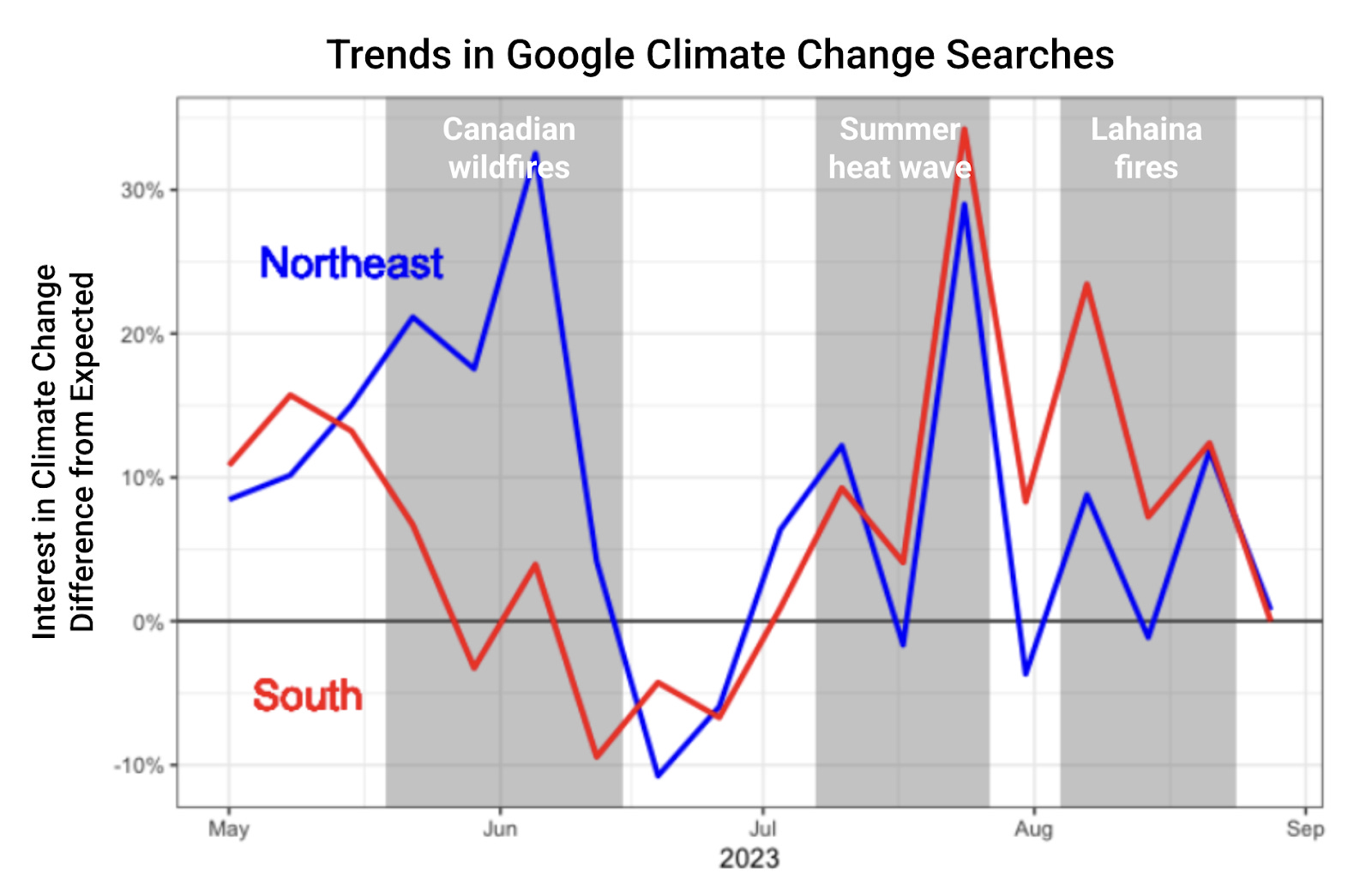
For example, the June 2023 Canadian wildfires led to higher than expected interest in climate change in the American Northeast, likely because the resulting smoke blanketed that region. Indeed, New York became the most polluted city in the world on June 6, 2023 due to the wildfire smoke. The American South did not experience similar levels of smoke exposure which is likely why the region did not see such a spike in climate change interest in that period. In contrast, the July 2023 heat wave that brought record-breaking temperatures across much of the country was accompanied by a higher than expected spike in climate change interest in both the Northeast and the South.
Looking at these Google Search trends, we can better understand when and where people are paying more attention to climate change and its impacts. These insights can then help institutions and businesses better meet the demand for relevant, time-sensitive information. More specifically, this type of analysis enables us to:
Engage audiences when awareness is highest
Use high-impact events as entry points
Help support the most under-prepared populations
Show how today’s disasters are different–and why that matters
For additional results, including how extreme weather events affect Google Search queries for climate change and more details on how to apply these findings, you can find the full Climate Note here.
For media inquiries, please contact Eric Fine and Michaela Hobbs.
For partnership inquiries, please contact Joshua Low.
As always, thanks for your interest and support of our work!